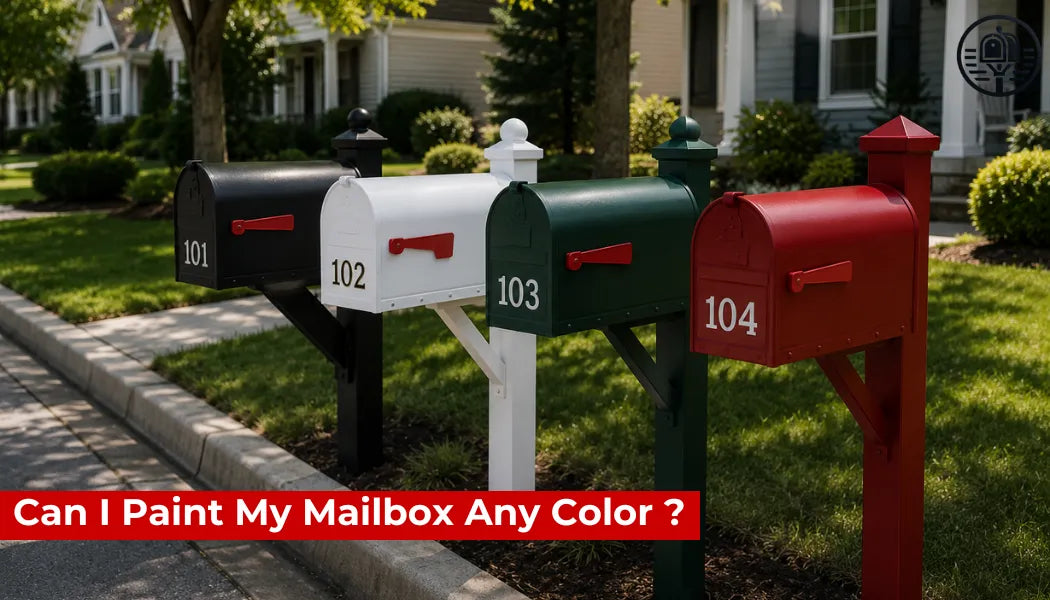
No — USPS does not require mailbox flags to be red. The only official requirement is that the flag must be a color that contrasts visibly with the mailbox so carriers can spot it from the road. Red became the standard by tradition, not by law.
Here's what USPS actually says, which colors work in practice, and the one situation where your HOA can override your choice.
What USPS Actually Requires for Mailbox Flags
The USPS mailbox flag requirement comes down to one functional principle : the flag must be visible enough for a carrier driving at normal route speed to see it raised from their vehicle.
USPS Publication 17 specifies that the flag must be a color that contrasts with the mailbox body. That's the complete regulation on color. There is no federal rule mandating red, no approved color list, and no fine for using a non-red flag that meets the visibility standard.
What USPS does regulate about flags :
- The flag must be mountable on the right side of a curbside mailbox (the flag side, facing traffic)
- It must be capable of being raised and lowered clearly — a flat position meaning no outgoing mail, raised meaning pickup requested
- It must not obstruct the mailbox door or interfere with mail deposit
The color is entirely the homeowner's choice within the visibility constraint.
📬 The one rule that actually matters : contrast, not color. A red flag on a red mailbox is non-compliant. A bright orange flag on a black mailbox is perfectly fine. The carrier needs to read the flag's position instantly from a moving vehicle — that's the standard everything else is measured against.
Why Red Became the Default
Red wasn't chosen by regulation — it emerged as a practical standard in the early 20th century when curbside delivery became widespread. At the time, most mailboxes were painted in muted, neutral tones (green, gray, cream) and red was the highest-contrast option available in durable outdoor paint.
The logic was simple : red is visible at distance, visible in fog and rain, visible against snow and against grass, and visible in low morning light when carriers start their routes. It became the industry standard for mailbox manufacturers and the consumer expectation that followed.
Today red remains the dominant flag color not because it's required but because it's genuinely the most visible option in the widest range of conditions. It's the right practical choice even if it's not the legal mandate.
🎨 Want a flag that matches your mailbox style? Our mailbox flag collection includes flags in multiple colors and finishes — all designed to meet the USPS visibility standard while complementing modern mailbox aesthetics. Compatible with standard curbside and post-mounted mailboxes.
Which Colors Actually Work as Alternatives
If you want a non-red flag, these colors perform well in real-world visibility conditions :
Orange — the strongest alternative to red. Slightly more visible than red in certain lighting conditions (dawn, dusk, overcast), used widely on safety equipment for the same reason. Excellent choice for any mailbox color.
Bright yellow — highly visible in most conditions but performs poorly against light-colored mailboxes or in snow. Works best on dark mailboxes (black, navy, dark green).
Bright blue — visible and increasingly popular for modern aesthetic mailbox designs. Less contrast in blue-sky backgrounds but generally sufficient for flag identification at route distance.
White — only works on dark mailboxes. Against a light mailbox or in winter conditions it becomes nearly invisible. Not recommended unless your mailbox is black or very dark.
Colors to avoid :
- Any color that matches or closely resembles your mailbox body
- Dark colors (navy, dark green, brown) — insufficient contrast in low light
- Metallic or reflective finishes without a solid base color — hard to read position from a distance
| Flag color | Best mailbox pairing | Visibility rating |
|---|---|---|
| Red | Any except red | ⭐⭐⭐⭐⭐ |
| Orange | Any except orange | ⭐⭐⭐⭐⭐ |
| Bright yellow | Dark mailboxes | ⭐⭐⭐⭐ |
| Bright blue | White, gray, cream | ⭐⭐⭐ |
| White | Black, dark green | ⭐⭐ |
The HOA Exception — When You Don't Have Full Freedom
USPS regulations set the floor — local rules can add requirements on top. Homeowners associations are the most common source of mailbox flag color restrictions.
Some HOAs require red flags specifically to maintain visual uniformity across the community. Others specify an approved list of colors. A few prohibit custom or non-standard mailbox hardware entirely.
If you live in an HOA-governed community, check your CC&Rs (Covenants, Conditions & Restrictions) before changing your flag color. An HOA can legitimately require red even though USPS doesn't. The consequence for non-compliance is typically an HOA notice and a requirement to replace — not a postal issue, but a neighbor dispute you don't need.
For homes without HOA governance, you have full freedom within the USPS visibility standard.
⚠️ Before you change anything Two quick checks : (1) search your HOA documents for "mailbox" — the flag color policy is usually in the exterior appearance section. (2) Look at your neighbors' mailboxes — if every single one has a red flag, that's a strong signal your HOA has a standard even if you haven't found it in writing yet.
Flag Maintenance — Often Overlooked
A faded, bent, or broken flag causes the same delivery problem as the wrong color — carriers miss it. A few practical points :
Fading is the most common issue with red flags specifically. UV exposure turns red flags pink or rust-colored within 2-3 years in sunny climates, reducing visibility significantly. Check your flag annually and replace when the color dulls noticeably.
Bent or stiff flags that don't sit cleanly in the raised or lowered position create ambiguity. If a carrier can't tell at a glance whether the flag is up or down, they may skip or misread it. The flag mechanism should move freely and hold its position.
Detached flags — if your flag has come loose or wobbles on its mount, replace the hardware before the next time you need to signal outgoing mail. A flag that falls mid-route means your outgoing mail sits in the box until the next delivery day.
FAQ
Does a mailbox flag have to be red? No — USPS does not require red. The only official requirement is that the flag color contrasts visibly with the mailbox body so carriers can spot it from the road. Red became the standard by tradition and practicality, not by law.
What color does USPS require for mailbox flags? USPS requires only that the flag be a contrasting color to the mailbox. There is no approved color list and no requirement specifying red. Any high-visibility color that stands out clearly against your mailbox is compliant.
Can I use an orange mailbox flag? Yes — orange is one of the best alternatives to red. It's highly visible across a wide range of lighting conditions and weather, and contrasts well with most mailbox colors.
What happens if my mailbox flag isn't visible enough? A carrier who can't clearly see the flag position may miss your outgoing mail. There's no fine for flag color under USPS rules, but the practical consequence is outgoing mail sitting in your box. Visibility is the functional requirement that matters.
Can my HOA require me to have a red flag? Yes. USPS regulations set the minimum standard but HOAs can add requirements. Some HOAs require red flags specifically for visual uniformity. Check your CC&Rs before changing flag color in an HOA-governed community.
How often should I replace my mailbox flag? Inspect annually. Replace when the color fades significantly, when the flag mechanism becomes stiff or loose, or when the flag no longer holds its raised or lowered position cleanly.
Do wall-mounted mailboxes need a flag? No — flags are specific to curbside post-mounted mailboxes used for USPS curbside delivery. Wall-mounted mailboxes typically don't have outgoing mail pickup service, so no flag is required or expected.