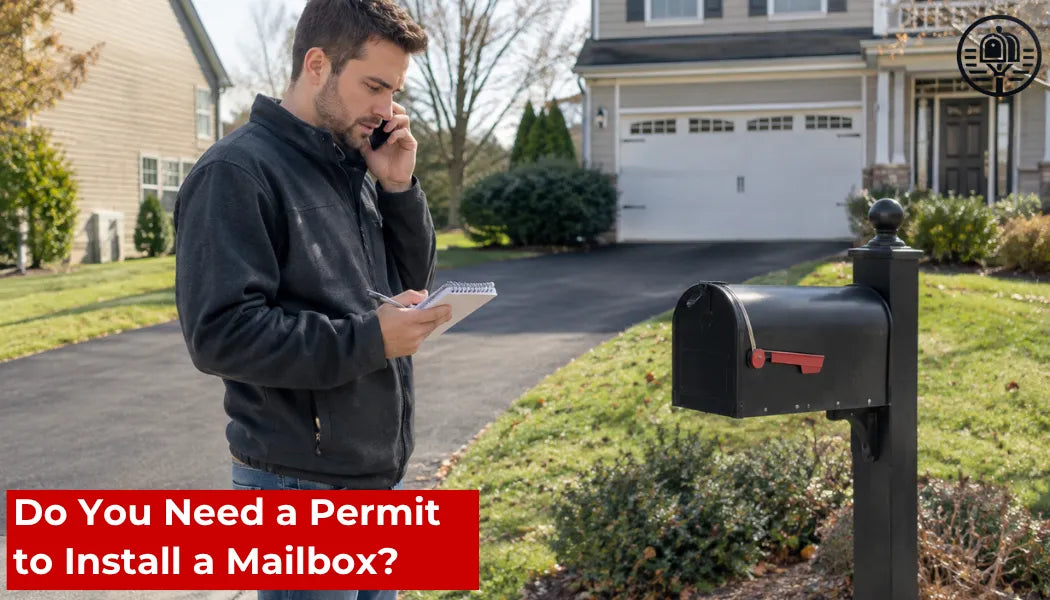
Quick Answer : In most cases, no — installing or replacing a residential mailbox on your own property doesn't require a building permit. Permits come into play in specific situations : installing a masonry or brick mailbox enclosure, placing a post inside a public right-of-way, working in a historic district, or in the small number of municipalities that regulate curbside structures explicitly. USPS federal requirements apply regardless of whether a permit does.
Here's when a permit is genuinely required, who to contact to confirm, and what rules apply to every installation even when no permit is involved.
Is a Permit Required for a Standard Mailbox Installation?
For the typical scenario — replacing a mailbox on an existing post, or setting a standard post in the ground at the edge of your own property — the answer is almost always no.
Building permits exist to regulate structures that affect safety, drainage, utilities, or the structural integrity of a property. A standard mailbox post, typically a 4×4 wooden post or a slim steel post set in a modest concrete footing, falls below the threshold that most municipal building departments regulate. It isn't habitable, it doesn't bear structural load, it doesn't connect to utilities, and it doesn't alter drainage in any meaningful way.
This is why the overwhelming majority of American homeowners install mailboxes without ever contacting a municipal office — and why doing so creates no issue in the vast majority of cases.
The exceptions, however, are real and worth knowing before you dig.
📬 Permit ≠ compliance
It's worth separating two different things. A permit is a municipal authorization to build. USPS compliance is a federal requirement about height, placement, and construction that applies whether or not any permit exists. Not needing a permit doesn't mean there are no rules — it means a different set of rules applies. See our complete guide to USPS mailbox regulations by state for the federal baseline and what individual states layer on top.
When Do You Actually Need a Permit?
Masonry and brick mailbox enclosures. This is the single most common situation where a permit genuinely applies. A brick or stone mailbox surround is a masonry structure with a real foundation, and many municipalities classify it as such for permitting purposes. Some jurisdictions go further and restrict or prohibit masonry mailbox enclosures near roadways entirely, on the grounds that they present a significant hazard in a vehicle collision — a brick column doesn't yield the way a wooden or steel post does.
If you're planning anything involving brick, stone, or concrete beyond a standard post footing, contact your municipal building department before starting.
Installations inside the public right-of-way. This is the detail that surprises most homeowners. The strip of land between the sidewalk and the street — and often several feet beyond — frequently belongs to the municipality or the state department of transportation rather than to the adjacent property owner, even though the homeowner maintains it.
Because mailboxes are by definition positioned at the road edge, many residential mailbox posts sit within this right-of-way. Most municipalities permit mailbox installation there by default as a recognized necessary use, but some require an encroachment permit, particularly on state-maintained roads or in newer developments with formally documented right-of-way boundaries.
Historic districts and design review areas. Properties within a designated historic district frequently fall under a design review process covering exterior modifications visible from the street — which includes mailboxes. This generally means approval of appearance rather than a structural permit, but it's a real approval step and bypassing it can result in a correction order.
New construction and subdivision development. For a home under construction, the mailbox is typically handled as part of the overall building permit rather than separately. If you're building, confirm with your builder whether the mailbox installation is included in their permitted scope.
Who Should I Contact to Confirm?
Three offices cover essentially every scenario, and a call to the right one takes a few minutes.
Your municipal building department handles permit questions for structures on private property. Ask specifically whether a mailbox post requires a permit, and mention the material if you're planning anything masonry.
Your public works or transportation department handles right-of-way questions. If you're unsure whether your mailbox location sits on your property or in the public right-of-way, this is the office that knows — and they can tell you whether an encroachment permit applies.
Your HOA, if you have one. Not a permit in the legal sense, but functionally a required approval in many communities, and often more restrictive than anything municipal. HOA covenants frequently specify approved mailbox styles, colors, materials, and sometimes a single mandated model. Check your CC&Rs before purchasing anything.
⚠️ The right-of-way question is the one worth asking
Of all the scenarios above, right-of-way is the most commonly overlooked and the most likely to apply to an ordinary homeowner. If your mailbox sits at the curb — which it does, by design — there's a reasonable chance part of that installation is on municipally owned land. In most places this is explicitly permitted for mailboxes. In some, it requires a form. One phone call settles it.
What Rules Apply Even Without a Permit?
Skipping the permit question entirely doesn't mean the installation is unregulated. Federal USPS requirements apply to every residential mailbox receiving mail delivery :
Height — the bottom of the mailbox opening must sit 41 to 45 inches above the road surface, measured from the road itself rather than the ground at the post base.
Curb distance — the front face of the mailbox door should sit 6 to 8 inches back from the face of the curb, or from the pavement edge on roads without a defined curb.
Construction — weather-resistant material, a door that closes and seals fully, and address numbers at least 1 inch tall in a contrasting color.
Carrier access — the mailbox must be reachable from a delivery vehicle without the carrier needing to exit, which means keeping the approach clear of parked vehicles, vegetation, and snow.
Failing these doesn't result in a municipal citation. It results in a USPS delivery suspension, which in practical terms is a more immediate problem than a permit issue would be. Our complete guide to mailbox installation walks through the full process including post depth, footing, and the final compliance check.
What Happens If You Install Without a Required Permit?
In the rare cases where a permit was genuinely required and wasn't obtained, enforcement is typically corrective rather than punitive on a first occurrence. A municipality discovering an unpermitted masonry mailbox enclosure will generally issue a notice requiring either retroactive permitting or removal, with a reasonable window to comply.
The more costly scenario is a right-of-way installation that conflicts with municipal work. A post set in the public right-of-way without an encroachment permit can be removed during road widening, utility work, or sidewalk installation, with no obligation on the municipality to replace or compensate. That's not a penalty — it's simply the consequence of building on land you don't own without authorization.
Neither outcome is severe. Both are entirely avoidable with a single phone call before installation.
🏠 Choosing a mailbox that avoids the question entirely
Standard post-mounted and wall-mounted mailboxes sidestep nearly all permit considerations, since they're not masonry structures and don't require a substantial foundation. Our modern mailbox collection and mailbox post collection are all USPS-compliant standard formats — which means for most homeowners, the only approval worth checking is the HOA.
FAQ
Do you need a permit to install a mailbox?
In most cases no. A standard residential mailbox on a wooden or metal post doesn't require a building permit in the vast majority of municipalities. Permits apply mainly to masonry enclosures, installations in a public right-of-way, and properties in historic districts.
Do I need a permit for a brick mailbox?
Often yes. A brick or stone mailbox enclosure is a masonry structure with a foundation and many municipalities classify it as permit-requiring. Some jurisdictions restrict masonry mailboxes near roadways entirely due to collision hazard. Contact your building department before starting.
Is my mailbox on my property or the public right-of-way?
Frequently the right-of-way, since mailboxes sit at the road edge by design. Your municipal public works or transportation department can confirm the boundary and tell you whether an encroachment permit applies.
Can my HOA require approval for a mailbox even if the city doesn't?
Yes. HOA covenants are separate from municipal permitting and are often more restrictive, commonly specifying approved styles, colors, or a single mandated model. Check your CC&Rs before purchasing.
What happens if I install a mailbox without a required permit?
Enforcement is usually corrective — a notice requiring retroactive permitting or removal. The bigger practical risk is a post in the public right-of-way being removed during municipal road or utility work with no obligation to replace it.
What rules apply if no permit is needed?
Federal USPS requirements still apply : 41 to 45 inches height from the road surface, 6 to 8 inches from the curb face, weather-resistant construction, visible address numbers, and clear carrier access. Failing these results in suspended mail delivery.
Who do I call to check if I need a permit?
Your municipal building department for structures on private property, your public works department for right-of-way questions, and your HOA for community covenants. One call to each covers every scenario.