Quick Answer : Yes, most standard homeowners policies cover mailbox damage under the “other structures” portion of the policy, typically for covered perils like vandalism, falling trees, or a vehicle collision. But in practice, filing is rarely worthwhile — a replacement mailbox and post usually costs $150 to $400, while a typical homeowners deductible runs $500 to $2,000. The claim is usually larger than the loss.
Here’s when coverage actually applies, when filing makes financial sense, and what to do in the far more common situation where it doesn’t.
Which Part of My Policy Covers a Mailbox?
Your mailbox falls under Coverage B — Other Structures, the portion of a standard homeowners policy that covers detached structures on your property : fences, sheds, detached garages, and yes, a mailbox on a post at the end of your driveway.
Coverage B is typically set at 10% of your dwelling coverage. On a home insured for $400,000, that’s $40,000 of other-structures coverage — far more than any mailbox could require. Capacity is never the issue with a mailbox claim.
The issue is the deductible, which applies to Coverage B exactly as it does to the main dwelling. A $1,000 deductible on a $250 mailbox replacement means you receive nothing and your claim history now shows an incident. Most homeowners who find themselves in this situation simply replace the mailbox directly — our modern mailbox collection covers the full range from basic replacements at $99.90 up to complete mailbox-and-post systems, which is typically well below any residential deductible.
💰 The arithmetic that decides almost every case
Average residential mailbox replacement including post and hardware : $150 to $400. Average homeowners deductible : $500 to $2,000. In the overwhelming majority of mailbox damage situations, the loss falls entirely below the deductible, which means no payout regardless of whether the peril was covered.
What Perils Are Actually Covered?
Standard HO-3 policies — the most common form in the US — cover other structures against a defined list of perils. For a mailbox, the relevant ones are :
Vandalism and malicious mischief. The classic baseball-bat mailbox destruction is a covered peril under most policies, and it’s also a federal crime. Worth noting : if the damage was deliberate, the incident should be reported to the USPS Postal Inspection Service regardless of whether you file an insurance claim — our guide on how to report mail theft and mailbox crimes covers the process and why federal jurisdiction applies.
Falling objects. A tree limb, a branch in a storm, debris carried by high wind. Generally covered.
Windstorm and hail. Covered under standard forms, though some policies in hurricane-prone coastal states carry separate wind deductibles that are significantly higher than the standard deductible.
Weight of ice, snow, or sleet. Covered, which occasionally applies to a mailbox crushed by an accumulated snow load or by snow pushed off a roof.
Vehicle impact — with an important exception. A vehicle striking your mailbox is covered, unless the vehicle is owned or operated by you or a member of your household. Backing your own car into your own mailbox is specifically excluded from Coverage B under most standard forms.
What Isn’t Covered?
Normal wear and deterioration. Rust, fading, a door hinge that failed after twelve years, a wooden post that rotted at ground level. Insurance covers sudden accidental damage, never gradual decline. This is the single most common reason a mailbox claim gets denied, and it’s also the most common actual cause of mailbox failure — see our guide on how often you should replace your mailbox for the realistic lifespan by material.
Damage from your own vehicle. As above — self-inflicted vehicle damage to your own other structures is excluded.
Snowplow damage in most cases. This is a genuine gray area. Municipal plow damage may be recoverable from the municipality rather than your insurer, depending on local policy and whether the mailbox was within the public right-of-way. Many municipalities have a formal claims process for plow damage, and some explicitly disclaim liability for mailboxes in the right-of-way. Check your city’s public works department before assuming either way.
Flood and earth movement. Excluded from standard policies entirely, requiring separate flood insurance.
Faulty installation. A post that was never set deep enough and leaned over after two freeze-thaw cycles is a workmanship issue, not a covered peril.
⚠️ The claim-history cost nobody factors in
Beyond the deductible math, filing small claims has a secondary cost. Insurers track claim frequency through industry databases, and a pattern of small claims can affect your premium at renewal or your eligibility when shopping policies — even for claims that paid out nothing. For a loss in the low hundreds, this alone usually settles the question.
When Does Filing Actually Make Sense?
There are specific situations where a claim is genuinely worth filing.
When the mailbox is part of a larger covered loss. If a storm took down a tree that damaged your roof, your fence, and your mailbox, the mailbox goes on the same claim. You’re paying the deductible regardless — including every damaged item maximizes the recovery.
When the mailbox is a substantial masonry structure. A brick or stone mailbox enclosure can cost $1,500 to $4,000 to rebuild, which comfortably exceeds most deductibles. This is the clearest case for a standalone mailbox claim.
When you have a low deductible. Policies with $250 or $500 deductibles exist, particularly on older policies or in certain states. At a $250 deductible, a $600 complete mailbox system replacement produces a meaningful recovery.
When the damage extends beyond the mailbox itself. Vehicle impact that destroyed the mailbox, tore up landscaping, damaged a retaining wall, or cracked the driveway apron adds up quickly past the deductible threshold.
What About Auto Insurance If a Car Hit My Mailbox?
This is often the better route, and it’s frequently overlooked.
If an identified driver struck your mailbox, their property damage liability coverage — mandatory in nearly every state — should cover the replacement with no deductible on your end. This is the cleanest outcome available in any mailbox damage scenario : full recovery, no deductible, no claim on your homeowners history.
Get the driver’s insurance information at the scene if possible, file a police report, and contact their insurer directly. Property damage liability claims for a few hundred dollars are routine and generally processed without friction.
If it was a hit-and-run, your options narrow. Homeowners coverage applies subject to your deductible. Some policies include limited coverage for unidentified vehicle damage. A police report is essential either way, both for any claim and in case the driver is later identified.
If it was a municipal vehicle — a plow, a sanitation truck, a utility vehicle — the municipality’s own claims process is the correct route rather than your insurer. Contact the relevant department directly; most have a standard damage claim form.
What Should I Do Immediately After Mailbox Damage?
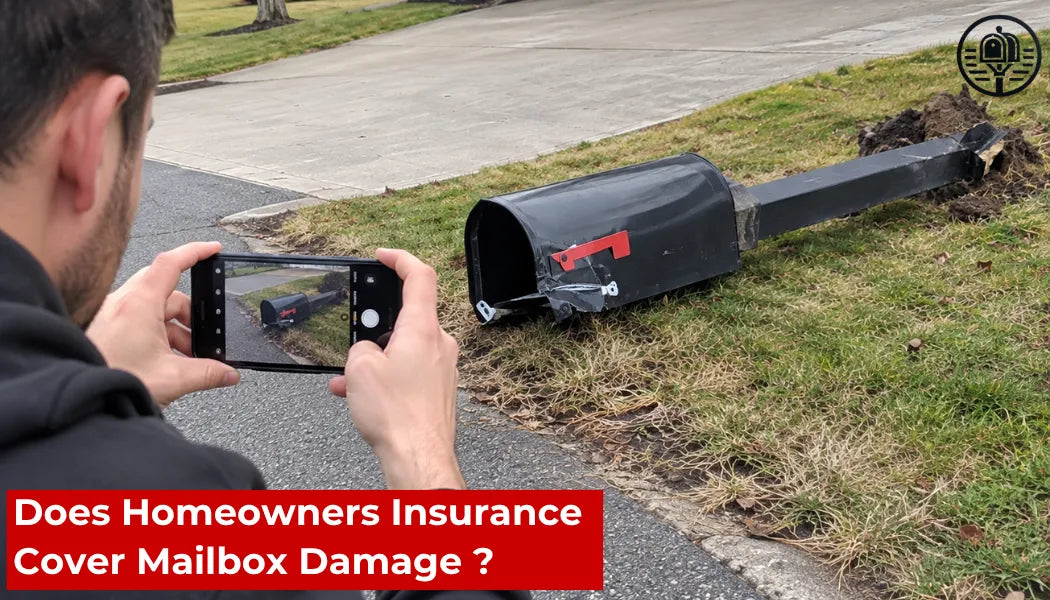
Photograph everything before touching anything. Multiple angles, wide shots showing the context and the position relative to the road, close-ups of the damage itself. Timestamped photos are the foundation of any claim, insurance or municipal.
File a police report for vandalism or vehicle impact. This serves double duty : it’s required for most claims, and mailbox destruction is a federal offense under 18 U.S.C. § 1705, which gives the incident weight beyond simple property damage.
Notify USPS. A destroyed or missing mailbox means delivery gets suspended and your mail is held at the local branch. Contact your post office so you know what’s being held and for how long, rather than discovering the situation a week later.
Get a replacement cost estimate before calling your insurer. Knowing that a replacement runs $250 before you call makes the deductible conversation take thirty seconds instead of starting a claim you’ll later withdraw.
Replace promptly regardless of the claim decision. Mail service doesn’t resume until a compliant mailbox is in place, and held mail starts returning to senders after roughly ten days.
📬 Worth upgrading while you’re replacing
A damage event is the one moment when replacement is already happening, which makes it the natural point to upgrade rather than reinstall the equivalent of what was there. If the previous mailbox was non-locking, or undersized for current package volumes, the incremental cost of a better unit is marginal compared to the replacement you’re already making.
Does a Mailbox Claim Raise My Premium?
Possibly, and this is the factor that makes small claims unattractive even when they’re technically payable.
A single small claim rarely triggers an immediate rate increase on its own. What affects premiums is claim frequency — insurers weigh the number of claims filed over a rolling period more heavily than the dollar amount of any individual one. Two or three small claims in five years can affect renewal pricing or eligibility more than a single large one.
Claims are also recorded in industry-wide databases accessible to other insurers, which means a claim history follows you when shopping for a new policy, not just with your current carrier.
For a mailbox specifically — where the loss is typically $150 to $400 — the sensible default for most homeowners is to absorb the cost directly, keep the claim history clean, and reserve filing for the situations outlined above where the numbers genuinely justify it.
FAQ
Does homeowners insurance cover mailbox damage?
Yes, under the “other structures” portion of a standard policy, for covered perils like vandalism, falling trees, windstorm, and vehicle impact. In practice most mailbox losses fall below the deductible, so coverage exists but rarely produces a payout.
Is it worth filing a claim for a damaged mailbox?
Usually not. Replacement typically costs $150 to $400 while deductibles run $500 to $2,000. Filing makes sense when the mailbox is part of a larger covered loss, when it’s a masonry structure, or when you have an unusually low deductible.
Does insurance cover a mailbox I hit with my own car?
No. Standard homeowners policies specifically exclude damage to other structures caused by a vehicle owned or operated by you or a household member.
What if someone else’s car hit my mailbox?
Their auto property damage liability coverage should pay for the replacement with no deductible on your end. This is the best outcome available — get their insurance information, file a police report, and contact their insurer directly.
Does insurance cover snowplow damage to a mailbox?
Often not through your homeowners policy. Municipal plow damage may be recoverable from the city through their own claims process, though many municipalities disclaim liability for mailboxes located in the public right-of-way. Check with your public works department.
Does homeowners insurance cover a rusted or worn-out mailbox?
No. Insurance covers sudden accidental damage, never gradual deterioration. Rust, fading, rotted posts, and failed hinges from age are all maintenance issues rather than covered perils.
Will a mailbox claim raise my insurance premium?
A single small claim rarely triggers an immediate increase, but insurers weigh claim frequency heavily. Several small claims over a few years can affect renewal pricing and your eligibility when shopping policies elsewhere.
How long do I have to file a mailbox damage claim?
Most policies require prompt notice, generally interpreted as within days to a few weeks. Check your specific policy language, and document the damage with photos immediately regardless of when you decide whether to file.